Genocide Never Again 7th Grade Unit 5rw
Click on any Question to Reveal the Corresponding Answer:
1. When speaking about the "Holocaust," what fourth dimension period are we referring to?
The "Holocaust" refers to the flow from January 30, 1933, when Hitler became Chancellor of Germany, to May eight, 1945 (5-E Day), the end of the war in Europe.
Click Hither for a timeline of Jewish persecution during the Holocaust era.
ii. How many Jews were murdered during the Holocaust?
While it is impossible to ascertain the verbal number of Jewish victims, statistics indicate that the total was over 5,860,000. Half dozen 1000000 is the round figure accustomed by almost regime.
Click HERE to acquire more than almost the Jewish victims of the Holocaust.
iii. How many non-Jewish civilians were murdered during World War Two in Europe?
While it is impossible to ascertain the exact number, the recognized figure is approximately 5,000,000. Among the groups which the Nazis and their collaborators murdered and persecuted were: Gypsies, Serbs, Polish intelligentsia, resistance fighters from all the nations, German opponents of Nazism, homosexuals, Jehovah's Witnesses, habitual criminals, and the "anti-social," east.1000. beggars, vagrants, and hawkers.
4. Which Jewish communities suffered losses during the Holocaust?
Every Jewish community in occupied Europe suffered losses during the Holocaust. The Jewish communities in North Africa were persecuted, just were not subjected to the aforementioned large-scale deportations or mass murder. Some individuals, however, were deported to German language death camps, where they perished.
Click HERE to learn more about the Jewish communities of Nazi-Occupied Europe.
5. How many Jews were murdered in each country and what pct of the pre-war Jewish population did they establish?
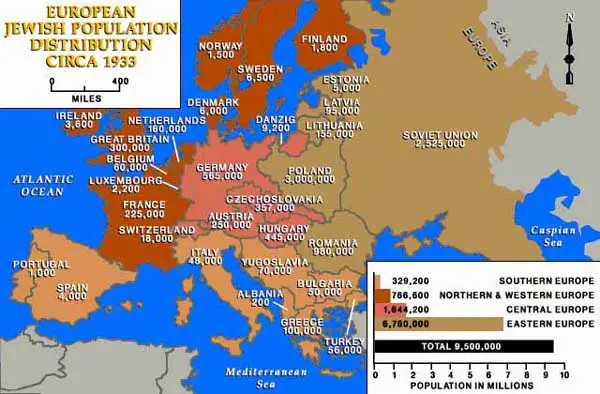
Republic of austria l,000 -- 27.0%
Italy 7,680 -- 17.three%
Belgium 28,900 -- 44.0%
Latvia 71,500 -- 78.1%
Bohemia/Moravia 78,150 -- 66.1%
Lithuania 143,000 -- 85.1%
Bulgaria 0 -- 0.0%
Luxembourg 1,950 -- 55.seven%
Denmark 60 -- 0.vii%
Netherlands 100,000 -- 71.iv%
Estonia 2,000 -- 44.iv%
Norway 762 -- 44.8%
Finland 7 -- 0.3%
Poland 3,000,000 -- 90.ix%
France 77,320 -- 22.i%
Romania 287,000 -- 47.one%
Germany 141,500 -- 25.0%
Slovakia 71,000 -- 79.8%
Greece 67,000 -- 86.6%
Soviet Wedlock 1,100,000 -- 36.4%
Republic of hungary 569,000 -- 69.0%
Yugoslavia 63,300 -- 81.2
six. What is a decease camp? How many were there? Where were they located?
A death (or mass murder) camp is a concentration camp with special appliance specifically designed for systematic murder. Six such camps existed: Auschwitz-Birkenau, Belzec, Chelmno, Majdanek, Sobibor and Treblinka. All were located in Poland.
Click Here to larn more than well-nigh the concentration camps.
vii. What does the term "Final Solution" hateful and what is its origin?
The term "Final Solution" (Endl"sung) refers to Federal republic of germany's plan to murder all the Jews of Europe. The term was used at the Wannsee Conference (Berlin; January 20,1942) where High german officials discussed its implementation.
Click HERE to learn more well-nigh the "Last Solution."
eight. When did the "Final Solution" actually brainstorm?
While thousands of Jews were murdered by the Nazis or died as a direct event of discriminatory measures instituted against Jews during the initial years of the Third Reich, the systematic murder of Jews did non begin until the German invasion of the Soviet Union in June 1941.
Click HERE for a timeline of Jewish persecution during the Holocaust.
nine. How did the Germans ascertain who was Jewish?
On Nov 14, 1935, the Nazis issued the following definition of a Jew: Anyone with three Jewish grandparents; someone with 2 Jewish grandparents who belonged to the Jewish community on September fifteen, 1935, or joined thereafter; was married to a Jew or Jewess on September xv, 1935, or married one thereafter; was the offspring of a matrimony or extramarital liaison with a Jew on or after September 15, 1935.
Click HERE to acquire more than about the Nuremberg Laws.
ten. How did the Germans treat those who had some Jewish blood but were not classified as Jews?
Those who were non classified as Jews only who had some Jewish claret were categorized equally Mischlinge (hybrids)and were divided into ii groups:
- Mischlinge of the first degree--those with two Jewish grandparents;
- Mischlinge of the second degree--those with one Jewish grandparent.
The Mischlinge were officially excluded from membership in the Nazi Party and all Party organizations (e.g. SA, SS, etc.). Although they were drafted into the Deutschland Army, they could not accomplish the rank of officers. They were also barred from the civil service and from certain professions. (Individual Mischlinge were, all the same, granted exemptions under certain circumstances.) Nazi officials considered plans to sterilize Mischlinge, just this was never done. During Globe State of war Ii, start-degree Mischlinge, incarcerated in concentration camps, were deported to expiry camps.
Click HERE to learn more than about the Nuremberg Laws.
xi. What were the first measures taken by the Nazis against the Jews?
The first measures against the Jews included:
Apr 1, 1933: A cold-shoulder of Jewish shops and businesses past the Nazis.
April 7, 1933: The law for the Re-establishment of the Civil Service expelled all non-Aryans (defined on April eleven, 1933 as anyone with a Jewish parent or grandparent) from the civil service. Initially, exceptions were made for those working since Baronial 1914; German veterans of Earth State of war I; and, those who had lost a father or son fighting for Germany or her allies in Earth State of war I.
Apr seven, 1933: The law regarding access to the legal profession prohibited the admission of lawyers of non-Aryan descent to the Bar. It also denied not-Aryan members of the Bar the right to exercise law. (Exceptions were made in the cases noted above in the law regarding the civil service.) Similar laws were passed regarding Jewish police force assessors, jurors, and commercial judges.
April 22, 1933: The decree regarding physicians' services with the national wellness plan denied reimbursement of expenses to those patients who consulted non-Aryan doctors. Jewish doctors who were war veterans or had suffered from the war were excluded.
Apr 25, 1933: The law against the overcrowding of German schools restricted Jewish enrollment in German loftier schools to 1.5% of the student torso. In communities where they constituted more than than v% of the population, Jews were allowed to constitute up to v% of the student trunk. Initially, exceptions were made in the case of children of Jewish war veterans, who were not considered function of the quota. In the framework of this law, a Jewish student was a kid with 2 not-Aryan parents.
Click HERE for a timeline of Jewish persecution during the Holocaust.
12. Did the Nazis plan to murder the Jews from the beginning of their regime?
This question is one of the most hard to answer. While Hitler made several references to killing Jews, both in his early writings (Mein Kampf) and in various speeches during the 1930s, it is fairly sure that the Nazis had no operative plan for the systematic annihilation of the Jews earlier 1941.
The decision on the systematic murder of the Jews was apparently made in the belatedly wintertime or the early jump of 1941 in conjunction with the decision to invade the Soviet Wedlock.
Click Here for a timeline of Jewish persecution during the Holocaust.
13. When was the first concentration campsite established and who were the beginning inmates?
The first concentration military camp, Dachau, opened on March 22, 1933. The campsite's first inmates were primarily political prisoners (e.g. Communists or Social Democrats); habitual criminals; homosexuals; Jehovah's Witnesses; and "anti-socials" (beggars, vagrants, hawkers). Others considered problematic by the Nazis (e.one thousand. Jewish writers and journalists, lawyers, unpopular industrialists, and political officials) were also included.
Click HERE to larn more about the Dachau Concentration Camp.
14. Which groups of people in Germany were considered enemies of the state past the Nazis and were, therefore, persecuted?
The post-obit groups of individuals were considered enemies of the Third Reich and were, therefore, persecuted past the Nazi authorities:
- Jews
- Gypsies
- Social Democrats and other opposing politicians
- Opponents of Nazism
- Jehovah'due south Witnesses
- Homosexuals
- Habitual criminals
- "Anti-socials" (e.1000. beggars, vagrants, hawkers)
- The mentally ill
Any individual who was considered a threat to the Nazis was in danger of beingness persecuted.
Click HERE to learn more about the victims of the Holocaust.
fifteen. What was the deviation between the persecution of the Jews and the persecution of other groups classified by the Nazis equally enemies of the Third Reich?
The Jews were the only group singled out for total systematic annihilation by the Nazis.
To escape the death judgement imposed by the Nazis, the Jews could only go out Nazi-controlled Europe. Every single Jew was to exist killed co-ordinate to the Nazis' plan. In the case of other criminals or enemies of the Third Reich, their families were usually not held accountable. Thus, if a person were executed or sent to a concentration camp, it did not mean that each member of his family would come across the same fate. Moreover, in about situations the Nazis' enemies were classified as such because of their deportment or political affiliation (actions and/or opinions which could be revised). In the example of the Jews, it was considering of their racial origin, which could never be changed.
Click Hither to larn more than about the victims of the Holocaust.
sixteen. Why were the Jews singled out for extermination?
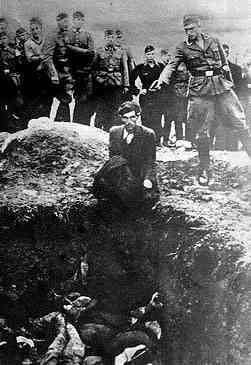
The caption of the Nazis' implacable hatred of the Jew rests on their distorted world view which saw history as a racial struggle. They considered the Jews a race whose goal was world domination and who, therefore, were an obstruction to Aryan dominance. They believed that all of history was a fight between races which should culminate in the triumph of the superior Aryan race. Therefore, they considered information technology their duty to eliminate the Jews, whom they regarded equally a threat. Moreover, in their eyes, the Jews' racial origin made them habitual criminals who could never be rehabilitated and were, therefore, hopelessly corrupt and inferior.
There is no doubt that other factors contributed toward Nazi hatred of the Jews and their distorted image of the Jewish people. These included the centuries-old tradition of Christian antisemitism which propagated a negative stereotype of the Jew as a Christ-killer, agent of the devil, and practitioner of witchcraft. Besides significant was the political antisemitism of the latter one-half of the nineteenth and early on part of the twentieth centuries, which singled out the Jew as a threat to the established gild of society. These combined to point to the Jew equally a target for persecution and ultimate destruction by the Nazis.
Click HERE to larn more about the Nazis and the Jews.
17. What did people in Germany know nearly the persecution of Jews and other enemies of Nazism?
Certain initial aspects of Nazi persecution of Jews and other opponents were common noesis in Frg. Thus, for case, everyone knew about the Boycott of April 1, 1933, the Laws of April, and the Nuremberg Laws, because they were fully publicized. Moreover, offenders were often publicly punished and shamed. The aforementioned holds truthful for subsequent anti-Jewish measures. Kristallnacht (The Night of the Broken Glass) was a public pogrom, carried out in full view of the entire population. While information on the concentration camps was not publicized, a nifty deal of information was available to the German public, and the handling of the inmates was mostly known, although exact details were not easily obtained.
As for the implementation of the "Terminal Solution" and the murder of other undesirable elements, the situation was different. The Nazis attempted to continue the murders a secret and, therefore, took precautionary measures to ensure that they would not be publicized. Their efforts, however, were only partially successful. Thus, for example, public protests by diverse clergymen led to the halt of their euthanasia programme in August of 1941. These protests were plainly the event of the fact that many persons were aware that the Nazis were killing the mentally ill in special institutions.
As far as the Jews were concerned, it was mutual knowledge in Germany that they had disappeared after having been sent to the E. It was not exactly clear to big segments of the High german population what had happened to them. On the other hand, in that location were thousands upon thousands of Germans who participated in and/or witnessed the implementation of the "Concluding Solution" either every bit members of the SS, the Einsatzgruppen, death army camp or concentration army camp guards, police in occupied Europe, or with the Wehrmacht.
18. Did all Germans support Hitler's plan for the persecution of the Jews?
Although the entire German language population was non in agreement with Hitler's persecution of the Jews, there is no prove of any large scale protest regarding their handling. At that place were Germans who defied the April 1, 1933 boycott and purposely bought in Jewish stores, and there were those who aided Jews to escape and to hibernate, but their number was very pocket-sized. Even some of those who opposed Hitler were in understanding with his anti-Jewish policies. Among the clergy, Dompropst Bernhard Lichtenberg of Berlin publicly prayed for the Jews daily and was, therefore, sent to a concentration campsite by the Nazis. Other priests were deported for their failure to cooperate with Nazi antisemitic policies, merely the bulk of the clergy complied with the directives against High german Jewry and did not openly protest.
19. Did the people of occupied Europe know about Nazi plans for the Jews? What was their attitude? Did they cooperate with the Nazis against the Jews?
The attitude of the local population vis-a-vis the persecution and devastation of the Jews varied from zealous collaboration with the Nazis to agile assistance to Jews. Thus, information technology is difficult to make generalizations. The situation also varied from land to state. In Eastern Europe and especially in Poland, Russian federation, and the Baltic States (Republic of estonia, Latvia, and Lithuania), in that location was much more than knowledge of the "Final Solution" because it was implemented in those areas. Elsewhere, the local population had less information on the details of the "Final Solution."
In every country they occupied, with the exception of Denmark and Bulgaria, the Nazis found many locals who were willing to cooperate fully in the murder of the Jews. This was particularly true in Eastern Europe, where at that place was a long standing tradition of virulent antisemitism, and where various national groups, which had been under Soviet domination (Latvians, Lithuanians, and Ukrainians), fostered hopes that the Germans would restore their independence. In several countries in Europe, there were local fascist movements which allied themselves with the Nazis and participated in anti-Jewish actions; for example, the Iron Guard in Romania and the Arrow Guard in Slovakia. On the other hand, in every country in Europe, there were mettlesome individuals who risked their lives to save Jews. In several countries, at that place were groups which aided Jews, east.g. Joop Westerweel's group in the Netherlands, Zegota in Poland, and the Assisi underground in Italy.
twenty. Did the Allies and the people in the Free World know about the events going on in Europe?
The various steps taken by the Nazis prior to the "Final Solution" were all taken publicly and were, therefore, reported in the press. Foreign correspondents commented on all the major anti-Jewish deportment taken by the Nazis in Deutschland, Austria, and Czechoslovakia prior to World War II. Once the war began, obtaining data became more difficult, simply reports, however, were published regarding the fate of the Jews.
Thus, although the Nazis did not publicize the "Final Solution," less than one year after the systematic murder of the Jews was initiated, details began to filter out to the West. The beginning report which spoke of a programme for the mass murder of Jews was smuggled out of Poland by the Bund (a Jewish socialist political organization) and reached England in the bound of 1942. The details of this report reached the Allies from Vatican sources as well every bit from informants in Switzerland and the Polish surreptitious. (Jan Karski, an emissary of the Smoothen clandestine, personally met with Franklin Roosevelt and British Strange Government minister Anthony Eden).
Eventually, the American Authorities confirmed the reports to Jewish leaders in late Nov 1942. They were publicized immediately thereafter. While the details were neither complete nor wholly accurate, the Allies were aware of virtually of what the Germans had done to the Jews at a relatively early engagement.
Click HERE to learn more about what the West knew and when they knew information technology.
21. What was the response of the Allies to the persecution of the Jews? Could they accept done anything to help?
The response of the Allies to the persecution and destruction of European Jewry was inadequate. Just in January 1944 was an agency, the State of war Refugee Board, established for the express purpose of saving the victims of Nazi persecution. Prior to that date, piddling action was taken. On December 17, 1942, the Allies issued a condemnation of Nazi atrocities confronting the Jews, but this was the only such declaration made prior to 1944.
Moreover, no attempt was made to call upon the local population in Europe to refrain from assisting the Nazis in their systematic murder of the Jews. Even following the institution of the War Refugee Lath and the initiation of diverse rescue efforts, the Allies refused to bomb the death camp of Auschwitz and/or the railway lines leading to that army camp, despite the fact that Allied bombers were at that time engaged in bombing factories very close to the camp and were well aware of its beingness and part.
Other practical measures which were not taken concerned the refugee trouble. Tens of thousands of Jews sought to enter the U.s.a., simply they were barred from doing and so by the stringent American clearing policy. Even the relatively small quotas of visas which existed were often not filled, although the number of applicants was ordinarily many times the number of bachelor places. Conferences held in Evian, France (1938) and Bermuda (1943) to solve the refugee trouble did not contribute to a solution. At the former, the countries invited past the United States and Great U.k. were told that no country would exist asked to change its clearing laws. Moreover, the British agreed to participate only if Palestine were not considered. At Bermuda, the delegates did not deal with the fate of those still in Nazi easily, simply rather with those who had already escaped to neutral lands. Practical measures which could have aided in the rescue of Jews included the post-obit:
- Permission for temporary admission of refugees
- Relaxation of stringent entry requirements
- Frequent and unequivocal warnings to Germany and local populations all over Europe that those participating in the annihilation of Jews would be held strictly answerable
- Bombing the expiry camp at Auschwitz
Click HERE to learn more than about U.S. policy during the Holocaust.
22. Who are the "Righteous Among the Nations"?
"Righteous Amid the Nations," or "Righteous Gentiles," refers to those non-Jews who aided Jews during the Holocaust.
There were "Righteous Amongst the Nations" in every country overrun or centrolineal with the Nazis, and their deeds often led to the rescue of Jewish lives. Yad Vashem, the Israeli national remembrance authorization for the Holocaust, bestows special honors upon these individuals. To date, later on carefully evaluating each case, Yad Vashem has recognized approximately 10,000 "Righteous Gentiles" in three different categories of recognition.
The country with the most "Righteous Gentiles" is Poland. The land with the highest proportion (per capita) is the Netherlands. The effigy of 10,000 is far from complete as many cases were never reported, oftentimes because those who were helped take died. Moreover, this figure only includes those who actually risked their lives to save Jews, and non those who merely extended help.
Click HERE to learn more most the "Righteous Amidst the Nations."
23. Were Jews in the Free Earth aware of the persecution and devastation of European Jewry and, if so, what was their response?
The news of the persecution and destruction of European Jewry must be divided into two periods. The measures taken past the Nazis prior to the "Terminal Solution" were all taken publicly and were, therefore, in all the newspapers. Strange correspondents reported on all major anti-Jewish deportment taken by the Nazis in Frg, Austria, and Czechoslovakia prior to World War 2. Once the state of war began, obtaining data became more than difficult, but, nonetheless, reports were published regarding the fate of the Jews.
The "Final Solution" was not openly publicized by the Nazis, and thus information technology took longer for information to reach the "Free World." Nevertheless, past December 1942, news of the mass murders and the plan to annihilate European Jewry was publicized in the Jewish printing.
The response of the Jews in the "Free World" must also be divided into two periods, before and after the publication of information on the "Final Solution." Efforts during the early years of the Nazi regime concentrated on facilitating emigration from Germany (although there were those who initially opposed emigration equally a solution) and combatting German language antisemitism. Unfortunately, the views on how to best reach these goals differed and effective action was often hampered past the lack of internal unity. Moreover, very few Jewish leaders really realized the scope of the danger. Following the publication of the news of the "Last Solution," attempts were made to launch rescue attempts via neutral states and to send assistance to Jews under Nazi dominion. These attempts, which were far from adequate, were further hampered by the lack of aid and obstruction from government channels. Additional attempts to achieve internal unity during this period failed.
24. Did the Jews in Europe realize what was going to happen to them?
Regarding the cognition of the "Final Solution" past its potential victims, several key points must be kept in mind.
First of all, the Nazis did non publicize the "Last Solution," nor did they always openly speak about information technology. Every endeavour was made to fool the victims and, thereby, prevent or minimize resistance. Thus, deportees were always told that they were going to be "resettled." They were led to believe that conditions "in the East" (where they were being sent) would be better than those in ghettos. Following arrival in certain concentration camps, the inmates were forced to write home nigh the wonderful conditions in their new place of residence. The Germans made every endeavor to ensure secrecy.
In addition, the notion that homo beings--permit lonely the civilized Germans--could build camps with special apparatus for mass murder seemed unbelievable in those days. Since German troops liberated the Jews from the Arbiter in World State of war I, Germans were regarded by many Jews equally a liberal, civilized people. Escapees who did render to the ghetto ofttimes encountered disbelief when they related their experiences. Even Jews who had heard of the camps had difficulty believing reports of what the Germans were doing there.
Inasmuch equally each of the Jewish communities in Europe was most completely isolated, there was a express number of places with available data. Thus, there is no doubtfulness that many European Jews were not aware of the "Final Solution," a fact that has been corroborated by German documents and the testimonies of survivors.
25. How many Jews were able to escape from Europe prior to the Holocaust?
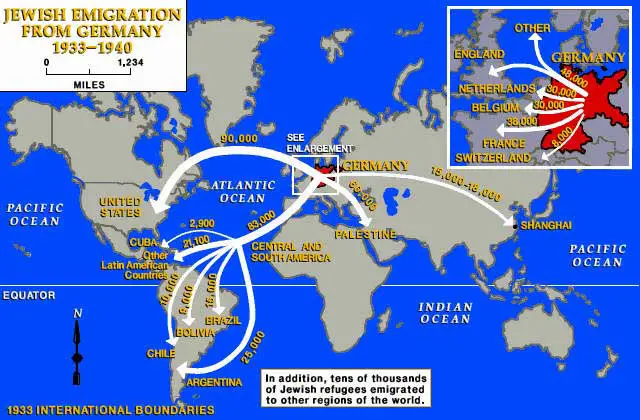
It is difficult to arrive at an exact figure for the number of Jews who were able to escape from Europe prior to World War II, since the available statistics are incomplete.
From 1933-1939, 355,278 German and Austrian Jews left their homes. (Some immigrated to countries later overrun by the Nazis.) In the same period, lxxx,860 Shine Jews immigrated to Palestine and 51,747 European Jews arrived in Argentina, Brazil, and Uruguay. During the years 1938-1939, approximately 35,000 emigrated from Bohemia and Moravia (Czechoslovakia). Shanghai, the just identify in the world for which one did not need an entry visa, received approximately 20,000 European Jews (mostly of German origin) who fled their homelands.
Immigration figures for countries of refuge during this menstruation are not available. In addition, many countries did not provide a breakdown of immigration statistics according to ethnic groups. Information technology is impossible, therefore, to ascertain.
Click Hither to learn more about survivors of the Holocaust.
26. What efforts were fabricated to save the Jews fleeing from Germany before World State of war 2 began?
Various organizations attempted to facilitate the emigration of the Jews (and not-Jews persecuted as Jews) from Frg. Among the most active were the Jewish Agency for Palestine, the American Jewish Joint Distribution Committee, HICEM, the Primal British Fund for German Jewry, the Reichsvertretung der Deutschen Juden (Reich Representation of German Jews), which represented German Jewry, and other non-Jewish groups such equally the League of Nations High Commission for Refugees (Jewish and other) coming from Germany, and the American Friends Service Commission.
Among the programs launched were the "Transfer Agreement" betwixt the Jewish Bureau and the German government whereby immigrants to Palestine were allowed to transfer their funds to that state in conjunction with the import of German appurtenances to Palestine. Other efforts focused on retraining prospective emigrants in order to increase the number of those eligible for visas, since some countries barred the entry of members of sure professions. Other groups attempted to help in various phases of refugee work: selection of candidates for emigration, transportation of refugees, aid in immigrant absorption, etc. Some groups attempted to facilitate increased emigration by enlisting the help of governments and international organizations in seeking refugee havens. The League of Nations established an agency to assist refugees simply its success was extremely limited due to a lack of political power and adequate funding.
The United states of america and Uk convened a briefing in 1938 at Evian, France, seeking a solution to the refugee problem. With the exception of the Dominican Commonwealth, the nations assembled refused to change their stringent immigration regulations, which were instrumental in preventing large-calibration clearing.
In 1939, the Intergovernmental Committee on Refugees, which had been established at the Evian Briefing, initiated negotiations with leading German officials in an try to arrange for the relocation of a significant portion of German Jewry. However, these talks failed. Efforts were made for the illegal entry of Jewish immigrants to Palestine as early on as July 1934, just were later halted until July 1938. Large-scale efforts were resumed under the Mosad le-Aliya Bet, Revisionist Zionists, and private parties. Attempts were also made, with some success, to facilitate the illegal entry of refugees to various countries in Latin America.
Click HERE to acquire more about international refugee policy before and during Earth War Two.
27. Why were so few refugees able to abscond Europe prior to the outbreak of World War Two?
The central reason for the relatively depression number of refugees leaving Europe prior to World War II was the stringent immigration policies adopted by the prospective host countries. In the U.s.a., for example, the number of immigrants was limited to 153,744 per year, divided by country of origin. Moreover, the entry requirements were then stringent that available quotas were often not filled. Schemes to facilitate immigration outside the quotas never materialized as the bulk of the American public consistently opposed the entry of additional refugees. Other countries, particularly those in Latin America, adopted immigration policies that were like or even more than restrictive, thus endmost the doors to prospective immigrants from the Third Reich.
Great U.k., while somewhat more liberal than the United States on the entry of immigrants, took measures to severely limit Jewish immigration to Palestine. In May 1939, the British issued a "White Paper" stipulating that simply 75,000 Jewish immigrants would be allowed to enter Palestine over the course of the adjacent five years (10,000 a year, plus an boosted 25,000). This decision prevented hundreds of thousands of Jews from escaping Europe.
The countries most able to accept large numbers of refugees consistently refused to open their gates. Although a solution to the refugee problem was the calendar of the Evian Conference, only the Dominican Republic was willing to approve big-scale immigration. The Us and Britain proposed resettlement havens in under-developed areas (due east.g. Republic of guyana, formerly British Guiana, and the Philippines), merely these were non suitable alternatives.
2 of import factors should be noted. During the period prior to the outbreak of World War II, the Germans were in favor of Jewish emigration. At that time, there were no operative plans to kill the Jews. The goal was to induce them to exit, if necessary, by the use of force. It is also important to recognize the attitude of German Jewry. While many German Jews were initially reluctant to emigrate, the majority sought to do and so following Kristallnacht (The Nighttime of Cleaved Glass), November nine-10, 1938. Had havens been available, more people would certainly have emigrated.
Click Here to learn more about international refugee policy before and during World State of war II.
28. What was Hitler'south ultimate goal in launching World War II?
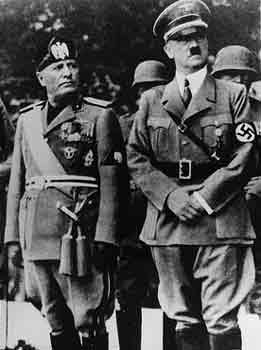
Hitler's ultimate goal in launching World War Ii was the institution of an Aryan empire from Germany to the Urals. He considered this area the natural territory of the German people, an area to which they were entitled by right, the Lebensraum (living infinite) that Germany needed so desperately for its farmers to have enough soil. Hitler maintained that these areas were needed for the Aryan race to preserve itself and assure its potency.
There is no question that Hitler knew that, by launching the war in the East, the Nazis would be forced to deal with serious racial bug in view of the limerick of the population in the Eastern areas. Thus, the Nazis had detailed plans for the subjugation of the Slavs, who would be reduced to serfdom status and whose principal function would exist to serve every bit a source of cheap labor for Aryan farmers. Those elements of the local population, who were of higher racial stock, would be taken to Germany where they would be raised as Aryans.
In Hitler'due south listen, the solution of the Jewish problem was likewise linked to the conquest of the eastern territories. These areas had large Jewish populations and they would have to exist dealt with accordingly. While at this point there was still no operative plan for mass annihilation, it was articulate to Hitler that some sort of comprehensive solution would take to be found. At that place was also talk of establishing a Jewish reservation either in Madagascar or well-nigh Lublin, Poland. When he made the decisive decision to invade the Soviet Union, Hitler also gave instructions to embark upon the "Concluding Solution," the systematic murder of European Jewry.
Click Here to learn more than about Nazi leader Adolf Hitler.
29. Was there any opposition to the Nazis within Germany?
Throughout the course of the Third Reich, there were different groups who opposed the Nazi regime and certain Nazi policies. They engaged in resistance at different times and with various methods, aims, and telescopic.
From the beginning, leftist political groups and a number of disappointed conservatives were in opposition; at a later date, church groups, regime officials, students and businessmen also joined. Later the tide of the state of war was reversed, elements within the military played an agile role in opposing Hitler. At no point, however, was at that place a unified resistance movement inside Germany.
Click Hither to learn more about the Nazi authorities in Germany during World State of war II.
xxx. Did the Jews effort to fight against the Nazis? To what extent were such efforts successful?
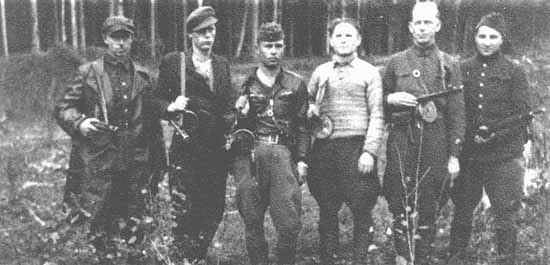
Despite the difficult atmospheric condition to which Jews were subjected in Nazi-occupied Europe, many engaged in armed resistance against the Nazis. This resistance can be divided into three basic types of armed activities: ghetto revolts, resistance in concentration and death camps, and partisan warfare.
The Warsaw Ghetto defection, which lasted for about 5 weeks outset on April nineteen, 1943, is probably the best-known example of armed Jewish resistance, but there were many ghetto revolts in which Jews fought against the Nazis.
Despite the terrible weather condition in the death, concentration, and labor camps, Jewish inmates fought against the Nazis at the following sites: Treblinka (Baronial 2, 1943); Babi Yar (September 29, 1943); Sobib>r (October 14, 1943); January>wska (November 19, 1943); and Auschwitz (October 7, 1944).
Jewish partisan units were active in many areas, including Baranovichi, Minsk, Naliboki forest, and Vilna. While the sum total of armed resistance efforts by Jews was not militarily overwhelming and did non play a significant office in the defeat of Nazi Germany, these acts of resistance did lead to the rescue of an undetermined number of Jews, Nazi casualties, and untold damage to German property and cocky-esteem.
Click HERE to learn more than most Jewish resistance during the Holocaust.
31. What was the Judenrat?
The Judenrat was the council of Jews, appointed past the Nazis in each Jewish community or ghetto.
According to the directive from Reinhard Heydrich of the SS on September 21, 1939, a Judenrat was to be established in every concentration of Jews in the occupied areas of Poland. They were led by noted community leaders. Enforcement of Nazi decrees affecting Jews and administration of the affairs of the Jewish community were the responsibilities of the Judenrat. These functions placed the Judenrat in a highly responsible, but controversial position, and many of their actions continue to be the bailiwick of fence among historians. While the intentions of the heads of councils were rarely challenged, their tactics and methods have been questioned. Among the nearly controversial were Mordechai Rumkowski in Lodz and Jacob Gens in Vilna, both of whom justified the cede of some Jews in gild to save others.
Leaders and members of the Judenrat were guided, for the virtually part, by a sense of communal responsibility, merely lacked the power and the means to successfully thwart Nazi plans for annihilation of all Jews.
Click Hither to acquire more almost the Judenrat.
32. Did international organizations, such as the Reddish Cross, aid victims of Nazi persecution?
During the form of World War II, the International Red Cross (IRC) did very little to aid the Jewish victims of Nazi persecution. Its activities tin can basically be divided into three periods:
i. September, 1939 - June 22, 1941:
The IRC confined its activities to sending food packages to those in distress in Nazi-occupied Europe. Packages were distributed in accordance with the directives of the German Red Cantankerous. Throughout this time, the IRC complied with the German contention that those in ghettos and camps constituted a threat to the security of the Reich and, therefore, were non allowed to receive aid from the IRC.2. June 22, 1941 - Summer 1944:
Despite numerous requests by Jewish organizations, the IRC refused to publicly protestation the mass annihilation of Jews and non-Jews in the camps, or to intervene on their behalf. It maintained that any public action on behalf of those under Nazi rule would ultimately prove detrimental to their welfare. At the same time, the IRC attempted to send food parcels to those individuals whose addresses it possessed.3. Summertime 1944 - May 1945:
Following intervention by such prominent figures equally President Franklin Roosevelt and the Rex of Sweden, the IRC appealed to Mikl>s Horthy, Regent of Hungary, to stop the deportation of Hungarian Jews.The IRC did insist that it be allowed to visit concentration camps, and a delegation did visit the "model ghetto" of Terezin (Theresienstadt). The IRC asking came following the receipt of information about the harsh living conditions in the camp.
The IRC requested permission to investigate the situation, but the Germans only agreed to let the visit ix months after submission of the request. This delay provided fourth dimension for the Nazis to complete a "beautification" programme, designed to fool the delegation into thinking that conditions at Terezin were quite good and that inmates were allowed to live out their lives in relative tranquility.
The visit, which took place on July 23, 1944, was followed past a favorable report on Terezin to the members of the IRC which Jewish organizations protested vigorously, demanding that another delegation visit the campsite. Such a visit was not permitted until before long earlier the cease of the war. In reality, the majority were subsequently deported to Auschwitz where they were murdered.
Click Hither to larn more about the worlds response to the Holocaust.
33. How did Frg'southward allies, the Japanese and the Italians, care for the Jews in the lands they occupied?
Neither the Italians nor the Japanese, both of whom were Germany's allies during World War II, cooperated regarding the "Terminal Solution." Although the Italians did, upon German urging, institute discriminatory legislation confronting Italian Jews, Mussolini'due south government refused to participate in the "Final Solution" and consistently refused to deport its Jewish residents. Moreover, in their occupied areas of France, Hellenic republic, and Yugoslavia, the Italians protected the Jews and did not let them to be deported. Notwithstanding, when the Germans overthrew the Badoglio regime in 1943, the Jews of Italy, as well as those under Italian protection in occupied areas, were bailiwick to the "Final Solution."
The Japanese were besides relatively tolerant toward the Jews in their country too as in the areas which they occupied. Despite pressure level past their German language allies urging them to take stringent measures against Jews, the Japanese refused to practice so. Refugees were allowed to enter Japan until the bound of 1941, and Jews in Japanese-occupied China were treated well. In the summer and fall of 1941, refugees in Nippon were transferred to Shanghai only no measures were taken against them until early on 1943, when they were forced to movement into the Hongkew Ghetto. While atmospheric condition were hardly satisfactory, they were far superior to those in the ghettos under German control.
Click HERE to acquire more than about Japan and the Jews.
34. What was the mental attitude of the church vis-a-vis the persecution of the Jews? Did the Pope ever speak out against the Nazis?
The caput of the Catholic Church at the time of the Nazi rise to ability was Pope Pius Xi. Although he stated that the myths of "race" and "blood" were reverse to Christian teaching (in a papal encyclical, March 1937), he neither mentioned nor criticized antisemitism. His successor, Pius XII (Primal Pacelli) was a Germanophile who maintained his neutrality throughout the course of World War 2. Although as early as 1942 the Vatican received detailed data on the murder of Jews in concentration camps, the Pope confined his public statements to expressions of sympathy for the victims of injustice and to calls for a more humane bear of the war.
Despite the lack of response by Pope Pius XII, several papal nuncios played an of import office in rescue efforts, particularly the nuncios in Hungary, Romania, Slovakia, and Turkey. It is not clear to what, if whatsoever, extent they operated upon instructions from the Vatican. In Germany, the Cosmic Church building did non oppose the Nazis' antisemitic campaign. Church records were supplied to state authorities which assisted in the detection of people of Jewish origin, and efforts to aid the persecuted were confined to Catholic non-Aryans. While Catholic clergymen protested the Nazi euthanasia plan, few, with the exception of Bernhard Lichtenberg, spoke out against the murder of the Jews.
In Western Europe, Cosmic clergy spoke out publicly confronting the persecution of the Jews and actively helped in the rescue of Jews. In Eastern Europe, notwithstanding, the Cosmic clergy was more often than not more reluctant to help. Dr. Jozef Tiso, the head of state of Slovakia and a Catholic priest, actively cooperated with the Germans every bit did many other Catholic priests.
The response of Protestant and Eastern Orthodox churches varied. In Deutschland, for example, Nazi supporters within Protestant churches complied with the anti-Jewish legislation and even excluded Christians of Jewish origin from membership. Pastor Martin Niem"ller's Confessing Church building defended the rights of Christians of Jewish origin within the church building, but did not publicly protestation their persecution, nor did it condemn the measures taken confronting the Jews, with the exception of a memorandum sent to Hitler in May 1936.
In occupied Europe, the position of the Protestant churches varied. In several countries (Denmark, France, the netherlands, and Norway) local churches and/or leading clergymen issued public protests when the Nazis began deporting Jews. In other countries (Republic of bulgaria, Greece, and Yugoslavia), some Orthodox church leaders intervened on behalf of the Jews and took steps which, in certain cases, led to the rescue of many Jews.
Click HERE to understand more almost the Vaticans' position during the Holocaust.
35. How many Nazi criminals were there? How many were brought to justice?
We practice not know the exact number of Nazi criminals since the bachelor documentation is incomplete. The Nazis themselves destroyed many incriminating documents and there are still many criminals who are unidentified and/or unindicted.
Those who committed state of war crimes include those individuals who initiated, planned and directed the killing operations, every bit well as those with whose cognition, understanding, and passive participation the murder of European Jewry was carried out.
Those who actually implemented the "Final Solution" include the leaders of Nazi Germany, the heads of the Nazi Political party, and the Reich Security Main Function. Also included are hundreds of thousands of members of the Gestapo, the SS, the Einsatzgruppen, the police and the armed services, every bit well equally those bureaucrats who were involved in the persecution and destruction of European Jewry. In addition, in that location were thousands of individuals throughout occupied Europe who cooperated with the Nazis in killing Jews and other innocent civilians.
We practise non have complete statistics on the number of criminals brought to justice, merely the number is certainly far less than the total of those who were involved in the "Final Solution." The leaders of the Third Reich, who were defenseless by the Allies, were tried by the International Military Tribunal in Nuremberg from November xx, 1945 to October 1, 1946. Afterwards, the Allied occupation authorities continued to try Nazis, with the almost significant trials held in the American zone (the Subsequent Nuremberg Proceedings). In total, 5,025 Nazi criminals were convicted between 1945-1949 in the American, British and French zones, in addition to an unspecified number of people who were tried in the Soviet zone. In addition, the United Nations War Crimes Commission prepared lists of war criminals who were later tried past the judicial authorities of Allied countries and those countries under Nazi rule during the war. The latter countries have conducted a large number of trials regarding crimes committed in their lands. The Polish tribunals, for example, tried approximately xl,000 persons, and large numbers of criminals were tried in other countries. In all, well-nigh 80,000 Germans have been convicted for committing crimes against humanity, while the number of local collaborators is in the tens of thousands. Special mention should be made of Simon Wiesenthal, whose activities led to the capture of over one m Nazi criminals.
Courts in Germany began, in some cases, to office equally early on as 1945. By 1969, almost eighty,000 Germans had been investigated and over 6,000 had been bedevilled. In 1958, the Federal Republic of Federal republic of germany (FRG; West Germany) established a special agency in Ludwigsburg to aid in the investigation of crimes committed past Germans outside Germany, an agency which, since its establishment, has been involved in hundreds of major investigations. One of the major problems regarding the trial of war criminals in the Frg (as well every bit in Republic of austria) has been the fact that the sentences accept been disproportionately lenient for the crimes committed. Some trials were also conducted in the former German language Democratic Commonwealth (GDR; East Germany), still no statistics be as to the number of those bedevilled or the extent of their sentences.
Click Hither to acquire more nigh the Nazi perpetrators of the Holocaust.
36. What were the Nuremberg trials?

The term "Nuremberg Trials" refers to two sets of trials of Nazi war criminals conducted after the war.
The get-go trials were held November 20, 1945 to October 1, 1946, earlier the International Military Tribunal (IMT), which was made up of representatives of French republic, United kingdom of great britain and northern ireland, the Soviet Union, and the U.s.. It consisted of the trials of the political, military and economic leaders of the Third Reich captured by the Allies. Amongst the defendants were: Chiliad"band, Rosenberg, Streicher, Kaltenbrunner, Seyss-Inquart, Speer, Ribbentrop and Hess (many of the most prominent Nazis -- Hitler, Himmler, and Goebbels -- committed suicide and were not brought to trial).
The second set of trials, known as the Subsequent Nuremberg Proceedings, was conducted before the Nuremberg Military Tribunals (NMT), established past the Office of the United states Government for Germany (OMGUS). While the judges on the NMT were American citizens, the tribunal considered itself international. Twelve loftier-ranking officials were tried, among whom were cabinet ministers, diplomats, doctors involved in medical experiments, and SS officers involved in crimes in concentration camps or in genocide in Nazi-occupied areas.
Click HERE to acquire more about the Nuremberg Trials.
Sources: Copyright The Simon Wiesenthal Heart
mcclearyroonstank.blogspot.com
Source: https://www.jewishvirtuallibrary.org/36-questions-and-answers-about-the-holocaust
0 Response to "Genocide Never Again 7th Grade Unit 5rw"
Post a Comment